Monday, January 23, 2017

Economic importance of Cyanobacteria | HSEB botany notes
Cyanobacteria are both useful as well as harmful to mankind and other living organism on the planet. The economic importance of cyanobacteria are as follows :


1. Cyanobacteria like Spriulina are cultivated in tanks as a protein rich food for fish and other animals.

2. Some blue green algae like Lyngbia can be used as antibiotics.

3. Species of cyanobacteria can grow on the walls and roofs of building during rainybseason causing discoloration, corrosion and leakage.

4. Nostoc sp benefits a number of plants with which it is associated by fixing nitrogen.

5. Even large colonies of Nostoc sp are edible.

Harmful effects :

6. Some cyanobacteria like Microcystis form water bloom on the surface of water and produce toxin ,and ultimatley pollute the water. The toxin is harmful to most aquatic animals and even to human beings.


Saturday, January 21, 2017

Hseb Botany | Short notes on Archaebacteria
Archaebacteria is the most primitive and ancient bacteria. They are supposed to be oldest of the living fossils. They possess a unique cell wall that consists of polysaccharide and protein. They lack peptidoglycan (murein). The cell membrane contains branched-chain lipids, which enable them to withstand extremes of heat, high PH, absence of oxygen and high concentration.


Based upon ecological properties , the archaebacteria can be classified into three groups :

1. Thermoacidophiles (Temperature and acid loving) : They are aerobic forms of bacteria found in hot sulphur springs. They are high temperature and acid loving cyanobacteria. At 80 C, they oxidize sulphur to sulphuric acid in highly acidic medium. Under aerobic condition , these sulphur-dependent bacteria are called thermoacidophiles. These can reduce sulphur to H2S under anaerobic conditions.

2. Methanogens (Methane producers) : These are anaerobic archaebacteria which occur in marshy places and convert the formic acid or CO2 to methane. In biogas plants, they produce the methane gas, which is used as fuel.

3. Halophiles (Salt loving) : These are anaerobic bacteria which occur at salt rich soils. They prepare pigmented membrane in the presence of sunlight. This process is different from that of eukaryotic photosynthesis.


Tuesday, December 13, 2016

HSEB notes | Difference between gram +ve and gram -ve bacteria.
The difference between gram +ve (positive) and gram -ve (negative) bacteria are as follows : 


Gram +ve bacteria
Gram –ve bacteria
1. Their cell wall is 100-200 A thick
      and homogenous.
1. Their cell wall is comparatively thin i.e 170-120 A and heterogenous.
2. They do not bear fimbriae or sex pilli.
2. They bear fimbriae or sex pilli
3. Peptidoglycan consists of about     70% of the cell wall.
3. Peptidoglycan consists of about 30% of the cell wall.
4. They retain deep blue or purple colour with crystal violet and subsequently with Potassium Iodide and alcohol.
4. They retain deep blue or purple colour with crystal violet and lost colour when treated with  Potassium Iodide and alcohol.
5. Mesosome is present.
5. Mesosome is absent.
6. They do not have resistant to Lysozome or antibiotics.
6. They show resistance with Lysozome or antibiotic due to the presence of lipid rich layer.

Monday, December 12, 2016

Solanaceae | Family Description | Biology - HSEB Notes


Distribution : They are distributed widely in the temperate and tropical region. Most of the plants belonging to this family are mesophytes. They are cultivated for vegetables , as They are cultivated for vegetables , as ornamental plant etc.

Habit :Most of them are annual herbs , rarely trees.


Vegetative characters


-  Root : Tap root system with lateral branches.

-  Stem : Erect , herbaceous , aerial , branched , solid or fistular , cylindrical. In some the stem is modified into tubers as in Solanum tuberosum.

-  Leaves : Cauline ,ramal, pertiolate or sessil or sub sessile , exstipulate , simple ,ovate , margin : dentate or entire , unicostate, reticulate venation


Floral characters


-  Flowers : Ebracteate , pedicellate , complete ,actinomorphic , rarely zygomorphic ,bisexual, pentamerous , hypogynous

- Inflorescence : Cymose , generallyaxillary but sometime extra-axillary or terminal cyme

-  Calyx : Sepal - 5 , gamosepalous , hairy , campanulate , inferior, valvate aestivation

- Corolla : Petal - 5 , gamopetalous , infundibuliform or tubular , inferior , valvate aestivation,

- Androceium : Stamen - 5, polyandrous , epipetalous , alternate to petal, anther : basifixed , dithecous ,introse

- Gynoceium : Carpel - 2 , bicarpellary , syncarpous , ovary superior and obliquely placed, bilocular with many ovaries on swollen placenta , sometime tetralocular due to development of false septum , aile placentation , style simple , stigma : capitate or bilobed

 Pollination : Cross , entomophilous

-  Fruit : A many seeded berry or capsule

-  Seed : Albuminous or endospermic which is curved or straight


Friday, December 9, 2016

HSEB botany notes | Economic importance of family Solanaceae
HSEB biology , botany notes : 

Economic importance of family Solanaceae are as follows: 


1. Vegetables : Most of the plant belonging to this family are cultivated for vegetable purpose. Some of them include Solanum tuberosum , Capsicum annum , Solanum melonfena , lycoprsicum esculentum etc. Tomoatos' is also used in making sauce.

2. Capsicum annum is used as condiment , in spices and beverage pungent.

3. Medicine : Dried leaves , stem and roots of Atropa belladona yield atropin which is relieve. Dried leaves and roots of Datura metel is used for treatment of asthama.

4. Edible fruit are obtained  from some species of this family like Rhasbari (from Physalis sp).

5. Nocotiana tobaccum is famous for chewing and for smoking but it's excess use can harm the body.

6. Ornamental purpose :  Cestrum diurnum , Cestrum , nocturnal , Cestrum elegans is used in garden as ornamental plant.

Wednesday, December 7, 2016

Cruciferae (Brassicaceae) | Family Description | Biology - HSEB Notes
This family comprises about 365 genera and 3250 species. 94 species of 38 genera have been reported in Nepal.

 Distribution : The family Cruciferae is cosmopolitan in distribution. Primarily, it is found in temperate zone of northern hemisphere. The plant of this family are cultivated for vegetables, oil yielding seed , ornamental purpose.

Habit : They are mostly herbs which may be annual , perennial , biennial and rarely small shrubs. The plant posses pungent sap having sulfur containing glucoside.  

Vegetative characters :

- Root : Tap root and branched. In some species , tap root is modified into napiform(Raphana      sativum) and fusiform (Brassica rapa).

- Stem : Erect , herbaceous rarely wooded , branched or unbranched , solid , cylindrical, hairy. The main stem is condensed   very much in some sepecies like Brassica rapa Raphana sativum etc.

- Leaves : Radical , cauline , ramal, alternate , petiolate or sessile , simple , lyrate , unicostate ,      reticulate venetion , hairy.


Floral characters :

- Inflorescence : Racemose type , generally raceme or corymb or corymboseraceme.

- Flower - Ebracteate , pedicellate , complete , bisexual , actinomorphic and rarely zygomorpohic, tertramerous , cruciform , hypogynous.

- Calyx : Sepal - 4, polysepalous , arranged in two whorls 2+2, inferior , petalloid , imbricate aestivation.

- Corolla : Petal - 4 ,polypetalous, each alternating with carpel , cruciform , valvate aestivation , inferior.

-  Androcieum : Stamen - 6, arranged in two whorls 2+4,  polyandrous , tetradynomous, outer two short and inner 4 long stamen, green nectrarial gland is present at the base of stamen,  anther is dithecious, basifixed, introse.

- Gynoceium : Carpel - 2 , bicarpellary , syncarpous , ovaries : superior , unilocular in the early stage and become bilocular  due to developmebt of false septum called replum, style is short and simple , stigma : capitate.

- Pollination : Cross , entomophilous , self sometime.

- Fruit : Siliqua or Silicula.


- Seed : Small , non-endospermic with curved embryo , cotyledon is oily. 


Picture from biologydiscussion.com


Monday, December 5, 2016

HSEB botany notes | Economic importance of Family Cruciferae or Brassicaceae
The economic importance of Family Cruciferae or Brassicaceae are as follows : 


1. Vegetables : The plant belonging to family cruciferae like Brassica rapa , Raphana sativum , Brassica juncea are used as vegetables. 

2.Condiments : Seeds of plants like Brassica nigra , Brassica juncea are used as spices and condiments.

3. Fodder : The mustard cake (remain of seed after extraction of oil, leaves of some plant of family is used as fodder.

4.Oil : Oil is extracted from seed of plants like Brassica campestris, Brassica juncea . This oil is used for cooking and burning purpose.

5. Ornamental purpose : Iberis amara , Lunaria is grown as ornamental plant.

6. Medicine : The seed of candytuft is used for treatment for gout and asthma. The root of Lepidium sativum is used against syphilis.


Tuesday, November 8, 2016

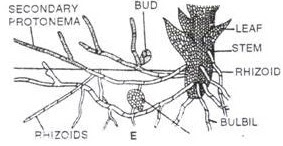
HSEB botany notes | Vegetative reproduction in Funaria (Moss) :
Vegetative reproduction in Funaria (Moss) :

In this method new plants are produced from vegetative part of the plant.
It take place by following methods:

Protonema


1. Primary protonema : The multicellular branched filamantous structure which bears
buds are calledas primary protonema. The protonema formed by germination of spores is callled as
primary protonema. The branches containg buds if seperate due disintegration of incalary cell
or by orther mean, each bud develop into new plant.


2. Seconday protonema : It is developed from any vegetative part of plant body other
than spore. Seonday protonema is similar to primary protonema in structure and
function . Their individual buds give rise to new plant.


3. Gemma : Gemma are the small multicellular structure developed from terminal cell
of protonema.If they get detached from parent body by any means, each gemma give rise
to new plant.

4. Tubers : Tubers are similar to gemma in function and structure excpet they develop from
rhizoid under unfavourable condition. When they get detached from the rhizoid,
each of them give rise to new plant under favourable condition.

5. Apospory : Apospory is the phenomenon of development of new plant directly from

wounded part of sporophyte whiout the occurance of meiosis cell division. The plant which

Sunday, October 30, 2016

HSEB botany notes | Morphology of funaria


The plant body of moss plant is foliose (Differentiated into axis and leaves) and gametophyte. The gametophytic body has upright , slender, and stem like axis which is about 1.3 or 1-3 cm long. The plant body is divided into rhizoid, stem and leaves :


1.   Rhizoid : It is borne from the basal part of the stem. It is multiccelar with oblique septa. At the young age it is colourless and thin walled and with maturity it becomes thick walled and yellowish brown or dark.brownish in colour. It fix plant the substratum and absorb water and mineral from soil.

2.   Axis : It is upright , erect , slender and green in colour. The branching is monopodial (branches arise from only one side of the plant) and extra auxiliary. The branches arise from lower portion of the plant. 

3.   Leaves : leaves are simple, sessile, erect and ovate with slightly serrate margin. It is bright green coloured with spirally arranged leaves on the steam. Each leaf has distinct midrib. The upper part of leaves is larger and crowded at the apex of the stem and lower part if the leaf is smaller and scattered on the stem.

Wednesday, October 19, 2016

HSEB notes | Difference Between Green Algae, Red Algae and Brown algae

Green Algae, Red Algae and Brown algae are grouped under the class Rhodophyceae

The comparison or difference between red algae(rodopyceae) and green algae(chloropyceae) and brown algae (Phaeopycea) are as follows :

 Chloropyceae - Green Algae


1.They are mostly found is freshwater form. (eg: Spirogyra sp, Chlamydomonas sp etc)

2. They are found mostly in Plantonic for i.e free floating form (eg: Spirogyra sp) and few are found in 
benthic form (eg : Ulothrix sp)

3. They store their reserved food in the form of starch.

4. The cell wall of Green Algae or Chloropyceae is made up outer pectose layer and inner cellulosic layer.

5. They contain photosynthetic pigment like chlorophyll a and b and xanthophyll and carotenoid. 

6. They are found in the range of microscopic unicellular and multicellular form.

7.Green algae reproduce by vegetative propagation by fragmentation,stolon , reproduce asexually by motile zoospore, apalanospore akinetic etc and sexuall reproduction is of isogamous, oogamous and anisogamous type.

Phaeopycea - Brown algae


1.They are mostly found is marine(eg : Fucus sp) form and few are found in  freshwater  form. (eg : Pleurocladia sp)

2. They are found mostly in Benthic form (eg: Fucus sp) and few are found in 
Plantonic form (eg : Laminaria sp)

3. They store their reserved food in the form of mannitol or laminarin.

4. The cell wall of Phaeopycea or Brown algae is made up outer phycocolloid layer and inner cellulosic layer.

5.They are found in the  multi-cellular form and unicellular form is unknown.

6. They contain photosynthetic pigment like chlorophyll a and c and xanthophyll and carotenoid. Brown colour is due to dominance of xanthophyll such as Fucoxanthin.

7. Brown algae reproduce by reproduce asexually by formation of motile or non-motile spores etc and sexual reproduction is of isogamous, oogamous and anisogamous type.


Rodophyceae - Red algae

1. 1.They are mostly found is marine(eg : Polysiphonia sp) form and few are found in  freshwater  form. (eg : Batrochospermom sp)

2. They are found mostly in Benthic form (eg: Polysiphonia sp) and few are found in 
Plantonic form (eg : Batrochospermom sp)

3. They store their reserved food in the form of floridean starch.

4. The cell wall of Rodophyceae - Red algae is made up outer pectic layer and inner cellulosic layer.

5. They are found mostly in the  form and multi-cellular form and few are found in uni-cellular form.

6. They contain pigment  phcyobilin such as phycoerthyrin (Red colour is due to dominance of phycoerthyrin)and phycocyanin (Blue colour).


7. Red algae reproduce asexually by formation of  non-motile spores such as carpospore, nuetral spore, meiospore , monospore etc and sexual reproduction is of  oogamous  type only.


Thursday, October 13, 2016

Economic importance of Algae | Botany XI | HSEB Notes

Algae


 Botany XI | HSEB notes|
The economic importance of different division of algae are as follows:

Chloropyceae (green algae)


1. Protococcus sp, Cladophora sp are the component for forming lichen family.

2. Spirogyra sp is used for making tissue paper.

Phaeophyceae (brown algae)


1. Seeweds such as Laminaria sp, fucus sp are used as fooder. They are rich in potakssiumso used as
fertilizer.
2. Laminaria sp and Ascophyllum sp (marine) posses antibiotic properties so used in
medical sector.
3. Alginate (salt of alginic acid) derieved from Laminaria sp is non-toxic so it is used
in making cosmetic , plastic and artificial fibre.


Rodophyceae (red algae)


1. Agar is excracted from pectic layer of some red algae such as Gelidium sp. This agar when comes
in contact with water can act as media for culture of bacteria, fungi etc. It is also
usedin making pills.

2.Bromine is excracted from Polysiphonia sp